Showing posts with label average uk house price. Show all posts

Thursday, 6 February 2025

Chichester named least affordable area outside London

Homes for first-time buyers in Chichester have been labelled the least affordable outside of London, according to data from Nationwide. The average home in the city costs 8.5 times the annual earnings of the typical local full-time worker.

A “modest improvement” in affordability across the UK was noted using the data, as wage increases had outpaced house price growth in the past 12 months, whilst mortgage rates had also come down slightly.

Nevertheless, affordability remains stretched by historical standings, with first-time buyers across the country typically faced with paying around five times their earnings for a home, compared to a long-run average of around four times.

The least affordable area in the UK was Kensington and Chelsea in London, where first-time buyers have to pay an average of 13.6 times earnings. On the other end of the scale, Aberdeen was the most affordable area to buy, with homes costing an average of 2.5 times local salaries.

Rising rents have made it especially difficult to save the necessary deposit to buy a home. It is thought that 40% of first-time buyers have some assistance in raising a deposit; either from an inheritance or a gift/loan from family. 


Further research by The Telegraph noted Chichester and Bognor Regis (as a combined area) as being the least affordable place in Sussex to live and work, when factoring in that 33.1% of a person’s income is spent on food, household bills and commuting costs.

The unaffordability of homes does not just affect youngsters of course. Older people who bought later in life can struggle to pay their mortgage before retirement. Then there are those who have never gotten on the ladder and need to keep a roof over their head when retired.

Despite these affordability challenges, house prices and mortgage market activity were resilient in 2024. House prices ended the year up by 4.7%, whilst mortgage approvals returned to pre-pandemic levels (despite average mortgage rates being around three times higher). 


Given all of the above, it is amazing to note that first-time buyers share of mortgages was higher in 2024 (54%) than before the pandemic in 2019 (51%); further reflecting a drop in landlords purchasing new rental properties.





Thursday, 15 September 2022

Property prices increased 14,202% during the Queen’s reign


Queen Elizabeth II’s glorious seventy-year reign has sadly come to an end. When she ascended to the throne in 1952 the average UK home cost just £1,891. Upon her death, the average property was worth £270,452 - an increase of 14,202% (meaning you could have bought 142 homes in 1952 for the same money as you can now)!

Back then the UK was mostly an island of renters though, with only around four million owning their own home, compared to 15 million homeowners today. Buyers in 1952 were typically paying four times the average salary for a home, compared to eight times today’s average salary now.

It’s not just property that has increased in price though; with a pint of milk costing 4p and a pint of beer costing 9p when the Princess became the Queen, times certainly have changed across the land!

Of course, that meteoric house price growth has not been linear, as the below chart shows:


Meanwhile, King Charles III will now move into the most expensive residential home in the world (Buckingham Palace, said to be worth over £1bn). If he were to oversee the same house price growth during his reign, the average UK home would be worth a fanciful £38.4m by the time his heir takes over…

It seems unlikely we’ll ever see such extravagant house price growth again (unless Sterling collapses into hyperinflation). It is also unlikely a future monarch will reach the great milestone of having a Platinum Jubilee, without a tragedy befalling the Royal family. Indeed, it could be several generations until we sing God save the Queen as part of our National Anthem, such is the lineage of the crown. 

I am sure many of you will join me in the sentiment of reflecting upon and thanking the Queen for her service, whilst wishing the best to King Charles III in helping towards a prosperous future for the UK.


This article was featured in...


Thursday, 4 August 2022

UK house prices are DOWN 11% since the credit crunch


With all the headlines about house prices being out of control as they continue to increase to ever higher record highs, you may think I’ve gone a little mad to even suggest property prices in the UK today are lower than they were 15 years ago (when the credit crunch kicked off in mid-2007).

Well, it is in fact true….sort of….

The average UK house price today according to Land Registry data is £283,496. This is indeed some 50% higher than the £188,691 the average UK home was worth in July 2007. However, that is when measuring it in Great British Pounds. Whilst that is certainly the logical thing to do when that is the currency we get paid in and use to pay our mortgages, it doesn’t tell the whole story.

Digging a little deeper shows that house prices have not risen at all….our ‘Great’ British Pound has merely become worth less….a lot less in fact when compared to the US Dollar - the ‘reserve’ currency that is widely used as the benchmark for trade around the world.

You see, in July 2007 when us Brits were paying £188,691 for the average home, we were also able to jet off to the US and exchange one of our pound coins for two US Dollars. That means we were effectively paying $377,382 for that ‘average’ UK home. As anyone who is currently wanting to exchange their pounds for dollars knows, you’ll get far fewer of them now when handing over the same amount of your hard earnt Sterling…with each pound currently being worth just 1.20 dollars. That means the current average UK property (costing £283,496) is actually worth just $340,195….11% less than 15 years ago.

Using the same formulae, the housing crisis in the US appears to be far more extreme than in the UK. The average US property currently costs $381,750, which is a 75% increase compared to their $217,839 peak in June 2007. Already then, our American cousins have seen prices rise far more in their native currency than we have in ours. But it gets worse for them when you consider the strength of the US Dollar. 

Had you emigrated to the US in the middle of 2007 you would have needed £108,920 to buy the average US home (for $217,839). If you now chose to come back to Britain, you could sell your average US home (for $381,750) and convert the sale proceeds back into £318,125….192% more than you started with 15 years ago!

It’s also interesting to look at median salaries both here in the UK and over the pond. Whilst the media shares stories of strikes and people bemoaning pay not keeping up with inflation (especially when it comes to house prices), between 2007 and now the UK median salary has increased by 30% (£24,043 in 2007 to £31,285 now). In the US that figure is a mere 13% ($59,534 in 2007 to $67,521 now). Of course, you now know that’s not the whole story as our pay in dollars has effectively dropped by 22%, whilst the American worker’s median pay has increased by 89% in pounds!


Coming back to the earlier point I made though; it is logical to simply focus on the currency we get paid in and use to pay for our housing. On that score this all adds up to the UK having seen house prices increase 50% since 2007, whilst wages have only increased by 30%. Clearly that’s not a good place to be, but it beats our American friends who have seen house prices increase 75% in the same timeframe, compared to receiving just a 13% rise in their incomes.

Even so, when it comes to affordability, property simply remains expensive in the UK for us Brits - the average home costing 9 times our median salary, whereas in the US, despite a sharper increase in house prices and a slower rise in salaries, they still ‘only’ require 5.7 times the median annual income to afford the average home.

Whilst you may think much of this is irrelevant, the fact is that the world is more inter-connected than ever before, so currency fluctuations distort our wealth on a global scale. We have largely been on the wrong side of this trade for the past 15 years, which is why we have seen a growing number of foreign individuals and companies purchasing property in the UK as it has become ‘cheaper’ in their native currencies.


This article was featured in...


Thursday, 9 June 2022

Property has increased 13,690% during the Queen’s reign

I hope you all had a wonderful long weekend celebrating the Queen’s Platinum Jubilee. As I watched the Queen step out on to the balcony of the most expensive residential home in the world (Buckingham Palace, which is worth over £1bn), I thought it might be interesting to see how property prices have changed since her accession to the throne on the 6th February 1952. 

Back then, the average price of a property in the U.K was just £1,891. Seventy years later and the average property now costs £260,771; an amount which would have bought you 138 homes in 1952! 

Back then the UK was mostly an island of renters though, with only around four million owning their own home, compared to 15 million homeowners today. Buyers in 1952 were typically paying four times the average salary for a home, compared to eight times today’s average salary now.

It’s not just property that has increased in price though; with a pint of milk costing 4p and a pint of beer costing 9p when the Princess became the Queen, times certainly have changed across the land!

Of course, that meteoric house price growth has not been linear, as the below chart shows:

This article was featured in...


Thursday, 14 April 2022

House prices rise three times faster than incomes in the past twenty years


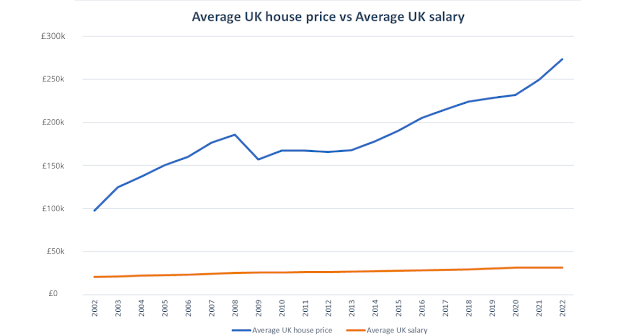
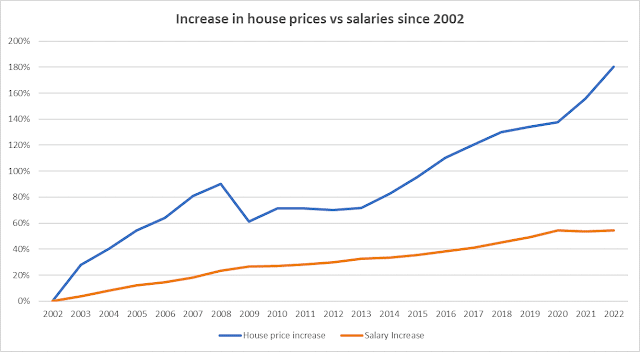
In 2002 the median salary in the UK had just broken through the £20,000 mark for the first time. Twenty years later and that median salary has increased by 54% to now stand at £31,461. Unfortunately, in a world of ever-rising prices, that won’t buy you 54% more stuff, with housing costs one of the most notable testaments to that fact. In the same two decades the average UK house price has increased by 180% (from £97,623 to £273,762), which is more than three times greater than salaries.

That means whereas it would have taken the average earner in 2002 a little under five years to afford to buy the average home (ignoring taxation), it would now take nearer nine years to do so. Plus, the deposit required has increased too, so that the fairly standard 10% deposit required has almost tripled from £9,762 in 2002 to £27,376 today.


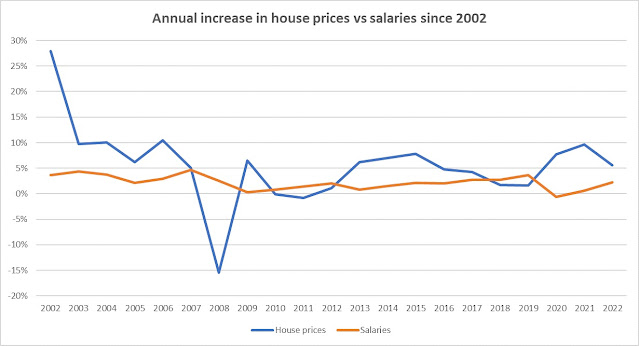
It’s interesting to note that salaries have been fairly steady in their rise, compared to the sharper fluctuations of house prices. Only once did average salaries not increase compared to the year before, whereas house prices saw that happen for several years during the ‘credit crunch’. That one time drop in salaries (of 0.6%) came in 2020, which was almost certainly due to covid stymieing incomes. Their biggest annual increase (4.7%) came in 2007, just before the credit crunch hit. In comparison, the annual change in house prices has been far less predictable, ranging from a drop of 15.4% (in 2008) to an increase of 27.9% (in 2002). 


The past decade has been a little steadier for house prices than the first decade of the millennium though; with their year-on-year change ranging from an increase of just 1.1% (in 2012) to 9.6% (in 2021). Notably, prices have ramped up in the past couple of years, with 2021’s gain having followed a 7.7% increase in 2020. That’s despite doom-mongers predicting a crash when Covid’s first lockdown was announced two years ago, with many would-be buyers even pulling out of purchases as a result. Since then, house prices have risen 18%, whereas incomes are still slightly below where they were when Covid struck.


The sudden jump in house prices these past two years, against a background of static incomes and other fast-rising costs (think energy and petrol prices), is why many are feeling the strain in their personal finances. Consider as well that our pound sterling has been decreasing in value against many other currencies, meaning our buying power is even weaker on a global basis. It is also why a lot of foreign money has come to the UK to sniff out property bargains (in their currency at least), making it even tougher for local workers to be able to afford local homes.


This article was featured in...