Showing posts with label uk house price increase. Show all posts

Thursday, 22 December 2022

House prices up 14,344% in seventy years


In 1952, the average UK home cost just £1,891. Seventy years later and the average property in the UK is now worth £273,135 - an increase of 14,344% (meaning you could have bought 143 homes in 1952 for the same money as you can now)!

Back then the UK was mostly an island of renters though, with only around four million owning their own home, compared to 15 million homeowners today. Buyers in 1952 were typically paying four times the average salary for a home, compared to eight times today’s average salary now.

It’s not just property that has increased in price though; with a pint of milk costing 4p and a pint of beer costing 9p back in 1952. That does mean though that property prices have outpaced the wider rate of inflation by some margin.

Of course, that meteoric house price growth has not been linear, as the below chart shows:


It seems unlikely we’ll ever see such extravagant house price growth again. To do so would mean the average UK home costing close to £40million in the year 2092! Then again, the way the financial markets have swung about this year, hyperinflation some time in the next seven decades could well make that impossible looking figure a reality. 


This article was featured in...


If you are looking for an agent that is well establishedprofessional and communicative in Chichester, then contact us to find out how we can get the best out of your investment property.

E-mail me on clive@crjlettings.co.uk or call 01243 624 599.

Don't forget to visit the links below to view my previous buy-to-let deals and Chichester Property News articles:

c/o CRJ Lettings, 30B Southgate, Chichester, West Sussex, PO19 1DP


Chichester rental valuation

Thursday, 14 April 2022

House prices rise three times faster than incomes in the past twenty years


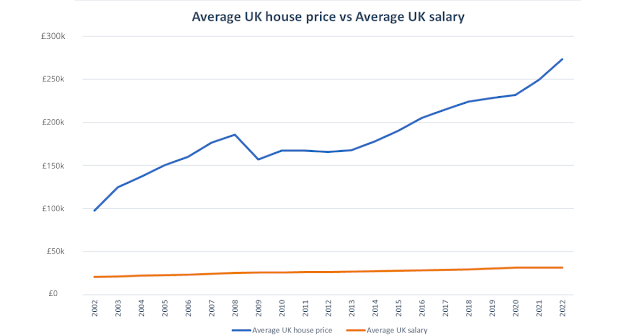
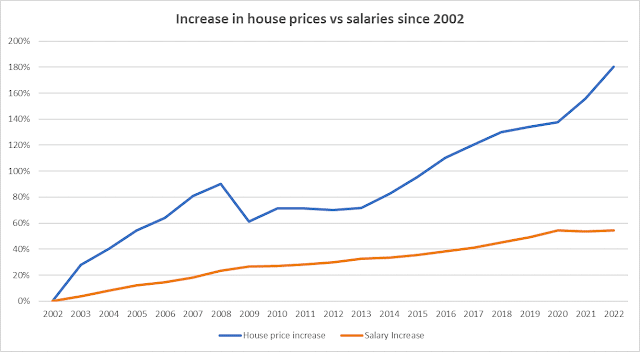
In 2002 the median salary in the UK had just broken through the £20,000 mark for the first time. Twenty years later and that median salary has increased by 54% to now stand at £31,461. Unfortunately, in a world of ever-rising prices, that won’t buy you 54% more stuff, with housing costs one of the most notable testaments to that fact. In the same two decades the average UK house price has increased by 180% (from £97,623 to £273,762), which is more than three times greater than salaries.

That means whereas it would have taken the average earner in 2002 a little under five years to afford to buy the average home (ignoring taxation), it would now take nearer nine years to do so. Plus, the deposit required has increased too, so that the fairly standard 10% deposit required has almost tripled from £9,762 in 2002 to £27,376 today.


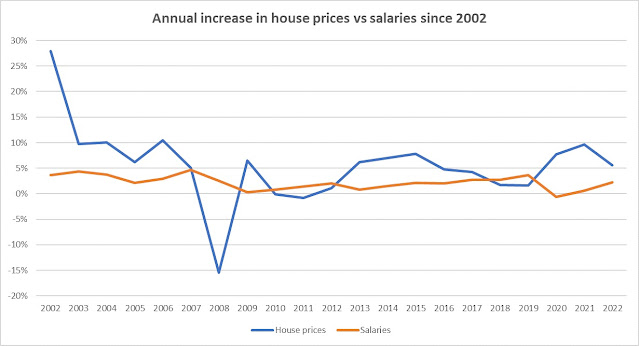
It’s interesting to note that salaries have been fairly steady in their rise, compared to the sharper fluctuations of house prices. Only once did average salaries not increase compared to the year before, whereas house prices saw that happen for several years during the ‘credit crunch’. That one time drop in salaries (of 0.6%) came in 2020, which was almost certainly due to covid stymieing incomes. Their biggest annual increase (4.7%) came in 2007, just before the credit crunch hit. In comparison, the annual change in house prices has been far less predictable, ranging from a drop of 15.4% (in 2008) to an increase of 27.9% (in 2002). 


The past decade has been a little steadier for house prices than the first decade of the millennium though; with their year-on-year change ranging from an increase of just 1.1% (in 2012) to 9.6% (in 2021). Notably, prices have ramped up in the past couple of years, with 2021’s gain having followed a 7.7% increase in 2020. That’s despite doom-mongers predicting a crash when Covid’s first lockdown was announced two years ago, with many would-be buyers even pulling out of purchases as a result. Since then, house prices have risen 18%, whereas incomes are still slightly below where they were when Covid struck.


The sudden jump in house prices these past two years, against a background of static incomes and other fast-rising costs (think energy and petrol prices), is why many are feeling the strain in their personal finances. Consider as well that our pound sterling has been decreasing in value against many other currencies, meaning our buying power is even weaker on a global basis. It is also why a lot of foreign money has come to the UK to sniff out property bargains (in their currency at least), making it even tougher for local workers to be able to afford local homes.


This article was featured in...